Black History Is Still Being Written — And It Starts With a Book


Often, when we celebrate Black History Month, we reflect on the past. We acknowledge that any societal progress for the rights of Black people stands on the shoulders of giants who have paved the way. When I first began writing this blog, I researched some of those giants to learn about some Black figures from Maryland who may not be so well-known. There’s Frances Ellen Watkins Harper, born in Baltimore in 1825 and the first African-American woman to publish a short story. What about Enolia P. McMillan, a Baltimore City Public Schools teacher turned the first female president of the entire NAACP? Or Josiah Henson, a person enslaved in North Bethesda, who went on to publish a novel and be the inspiration behind Harriet Beecher Stowe’s Uncle Tom’s Cabin.
These stories are beyond important, but we also want to honor the Black history that’s currently being made. Wes Moore, the first Black governor of Maryland, is also the singlemost Black governor in the country, and only the third Black governor in our nation’s history. Currently, the Legislative Black Caucus of Maryland is made up of the 66 Black legislators in Maryland’s General Assembly, which is the largest Black Caucus in the country. In 2025, these legislators created the Maryland Reparations Commission, dedicated to researching our state’s history of slavery, redlining, and segregation in order to improve today’s quality of life for all Marylanders.
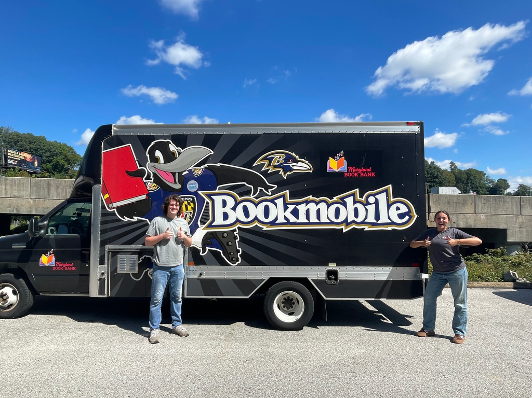
We know that Maryland is making history, and the Maryland Book Bank follows suit. During Black History Month, we stocked both of our Ravens Bookmobiles with a row dedicated to uplifting the stories of civil rights heroes, prolific abolitionists, and other Black revolutionaries. We’ve also recently created a standing section in our non-fiction area of the Book Bank called “Black History,” which will be available all year long. Since all of the books that we distribute are donated, we can’t always keep up with the demonstrated need for these sections (see our recently-updated BHM-focused Amazon wish list here). On the first Wednesday of February, when our Book Bank had a display created for Black History Month, the community took every single book from the display before the Book Bank closed that day. We know that these stories exist and that they matter to the community we serve.
The books and stories that I see every day remind me that Black history is still being made. Recently, during our sorting process, I stumbled across a book called Black Girl Rising. After we put it on the truck, it was chosen by a student on the Bookmobile the very next visit. When I looked into the book, which was written by Brynne Barnes and illustrated by Tatyana Fazlalizadeh, I found this quote, which I think perfectly exemplifies how a story can acknowledge the past, present, and future: “A love letter to and for Black girls everywhere, Black Girl Rising alchemizes the sorrow and strength of the past into the brilliant gold of the future, sweeping young readers of all backgrounds into a lyrical exploration of what it means to be Black, female, and glorious.”
It’s exciting to think about how many Black icons are making their mark today. Recently, I saw a Little Golden Book about Serena Williams. Little Golden Books are a series of books that were originally created to make reading more accessible for families by decreasing the cost of a picture book. Today, Little Golden Books signify treasured tales at affordable prices (Barnes and Noble sells a K-Pop Demon Hunters Little Golden Book for $6.99). Seeing a Serena Williams book brought me so much joy, not just because Serena Williams is iconic, but because I know that a Black child seeing a respected publication distributing a book about one of the most prolific Black athletes of our time and the highest-earning female athlete in history is Black history.
This Black History Month, I’ve been reflecting on how our mission at the Maryland Book Bank aims to cultivate our state’s future leaders. Students gaining confidence in reading and having consistent access to high-quality and diverse books will improve their academic outcomes, cultural awareness, and self-esteem. Our future revolutionaries are growing up right now, and every single person who works to increase literacy in historically under-resourced communities is a part of building a stronger and more equitable future. Who knows - there could be a child on a Bookmobile visit who becomes a sort of giant like Harper, McMillan, or Henson. Their journey to success starts today, with us.


Comments