Books Without Barriers: Why Spanish-Language Books Matter

Updated: Feb 5
As of 2019, more than 67 million people in the United States speak a language other than English at home. Spanish accounts for 62% of that group, making it the most commonly spoken non-English language in the country. Maryland reflects this national trend. According to recent data from the Migration Policy Institute, a substantial share of Maryland’s children (those between the ages of 5-17) speak Spanish at home. While many of them feel confident speaking English, over 35,000 do not. This number is significant and represents tens of thousands of students navigating school, literacy, and daily life without full linguistic access.
This is why organizations like CASA stand out. CASA is a national organization “building power and improving the quality of life in working class, Black, Latino/a/e, Afro-descendant, Indigenous, and immigrant communities.” Their programming has a strong presence in Maryland, and they offer adult ESOL (English for Speakers of Other Languages) classes throughout the state. When reading through their programs, I was struck by their philosophy when it comes to ESOL, which is based on the ideas of Popular Education.
Coined by 20th century Brazilian educator Paulo Freire, Popular Education emphasizes intertwining education with the lived experiences of the learners themselves. For example, a person who has never taken a math class and does not know how to multiply or divide numbers should not be expected to succeed in an algebra class. Similarly, it would seem ridiculous to expect a linguistics professor to be stimulated in an elementary English class.
Maryland’s own education system already reflects this principle by separating students by grade and skill levels. Within any grade, there are likely multiple levels of student comprehension, separated by classes, in order for educators to meet their students’ diverse learning needs. CASA applies this same logic to explain the necessity of ESOL and language instruction: if we intend to increase literacy, classroom achievement, and test scores, non-English speakers must receive the same level of targeted support as their peers.
As the 20th century philosopher Ludwig Wittgenstein observed, “The limits of my language are the limits of my world.” A growing body of research shows that bilingual education expands those limits by increasing academic performance, improving career outcomes, and strengthening cross-cultural empathy. The job market reflects this reality: a 2019 study found that individuals who can speak another language saw a 35% increase in job prospects. In an area such as Montgomery County, for instance, where 13.8% of its residents are Hispanic, businesses hoping to effectively operate would benefit from hiring bilingual employees who can communicate with this population.
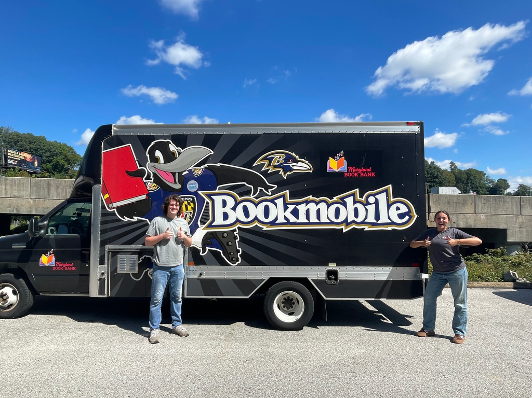
At the Maryland Book Bank, we know that our vision of a state where all students can thrive means not leaving anyone behind, including our littlest Spanish readers. On the Bookmobile, which targets Title One schools in Baltimore City, we stock at least two rows of books in Spanish for each and every visit because we see their demand in real time. During our public hours in the Book Bank twice a week, I can almost guarantee at least one request for books in Spanish from a community member. At its best, our stock of these books is fluctuating. At its worst, it’s scarce. Essentially, we can never meet the demonstrated need in the community, even though books in Spanish have their own protocol in our sorting process and are separated out.
During our volunteer sessions, we instruct our participants to put aside any and all books in Spanish in its own box in order to efficiently create our Spanish rows on the Bookmobile and in the Book Bank. My personal favorite books that come into this section are bilingual, meaning that the story is written in Spanish and English. Dolly Parton’s El Abrigo de Muchos Colores (A Coat of Many Colors) is an example of this. Research shows that a non-native English student will more quickly learn literacy skills in English by gaining proficiency in their home language first. This is because the same skills of learning phonics, letter sounds, and grammar rules in one language is the same process of gaining reading comprehension in English. Because of this, bilingual books offer students the best of both worlds - their English literacy improves alongside their Spanish.
The inclusion of books in Spanish at the Book Bank is an integral part of fostering a literacy ecosystem in Maryland (see my last blog about this concept here). We know that Spanish-speaking students abound in our state, bilingualism is a strength in several areas and should not be neglected, and we want to improve literacy throughout our state. Maryland’s future depends on the success of all its students, including the tens of thousands who are still developing confidence in English. Books in Spanish are not an optional add-on; they are a foundational part of equitable literacy work.
When a student finds a book in Spanish on the Bookmobile, I can see the relief on their face. This is because they are not just receiving a story - they are receiving affirmation that their identity belongs in the world of books, and this is a necessary part of the work we do at the Book Bank.
As we continue building our ecosystem, we invite our community to join us. If you can donate Spanish-language books, volunteer your time to sorting stories, or simply advocate for the value of multilingual literacy, these contributions help to create a Maryland where every student has the opportunity to grow.



Comments