The Right To Read

As I round out my fifth week working at the MBB, something that has continuously stuck out to me as a core principle of the Book Bank is the idea of books as a fundamental right. This concept is something that Kim, our lovely Program Director, is a huge advocate for:
“Literacy is not a luxury. Books are a human right. They are the building blocks of equity, empathy, and opportunity. Access to books should never depend on a family’s zip code or income. Every child deserves the chance to see themselves in a story and to believe that their story matters too.” - Kim
But, what does books as a human right really mean? It encompasses a wide range of ideas, such as freedom of speech, intellectual freedom, academic freedom, and book access.
Books, and the ability to read, are what make our society work, and the necessity of literacy has deep historical roots. In the 1600’s, philosopher John Locke popularized the concept of “tabula rasa,” which translates to “blank slate.” It acknowledges the idea that every child’s mind starts as a blank slate, in which home and school fill in those blanks. Therefore, children must be able to read about new concepts in order to form their own opinions about the world. This idea can even be traced back to Aristotle, who lived in the mid-300 B.C.’s! In his text De Anima (On the Soul), published in 350 B.C., he theorized that all learning begins with our external experiences.
Throughout history, the ability to read has played a crucial role in society’s progress. Reading the news has allowed citizens to stay informed and form judgments about significant world events like social justice movements, global pandemics, elections, natural disasters, international conflicts, and public health breakthroughs. Reading books has led to countless personal revelations, new levels of understanding for experiences different from our own, and inspirations for new technology. In fact, a series of interviews in 2015 found that 1,200 of the world’s wealthiest people are avid readers.
As The National Literacy Institute puts it, “Literacy is the foundation on which we build full, productive lives - as individuals, as communities, and as a nation.” Therefore, books, and a comprehensive reading curriculum during critical literacy ages, serve as a fundamental human right.
However, as human rights so often are, access to books is continuously lacking in the ways it reaches people throughout the country. As of 2024, about 21% of adults in the US are illiterate, with the US ranking 36th in the world for literacy. This is due to a combination of factors, including a nationwide teacher shortage, poverty levels, and other systemic issues facing communities around the country. In Baltimore City, these issues persist, with only 13% of fourth-grade students performing at or above the national standards for reading levels.
Many people, particularly those in historically marginalized communities, face economic barriers to accessing books. These barriers can include lack of transportation to libraries or other resources, living in a library desert (a geographic area where the majority of its residents do not have access to public libraries or bookstores within a one-mile radius), homelessness, or limited access to basic necessities such as food or clean water.
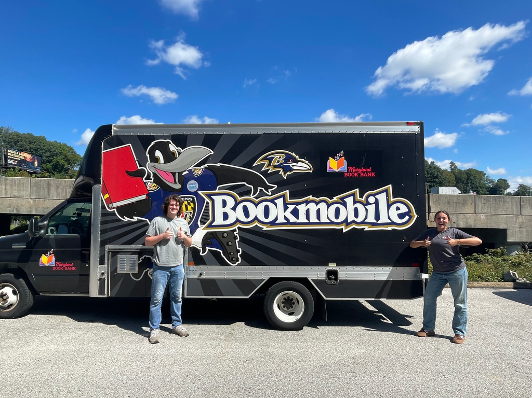
At the MBB, our mission of expanding equitable access to books is deeply rooted in books as a human right. We understand that the barriers that children face to accessing books are out of their control, so we aim to eliminate those barriers. One of the ways we do this is using the Bookmobile. As its name suggests, the Bookmobile is a mobile library that we bring to Title I schools throughout Baltimore City, and to other schools and events throughout all of Maryland. By bringing books to the children, we eliminate transportation barriers that children may face, including limited access to a reliable public transit system or a car.
The Book Bank, our warehouse’s public side, also eliminates financial barriers by making every book that members of our community take home completely free. Every single person who walks into the Book Bank can take up to 25 books home, free of charge. To me, this is miraculous. During our public hours, we see educators looking to sustain their classroom libraries, parents with their children browsing for books to read for bedtime, and community members whose specific needs are met by the Book Bank. For educators and families looking for more than 25 books, we offer a low-cost membership of $45 per year for unlimited books every time they visit the Book Bank (and children visiting our space can always take home “as many books as they can carry,” free of charge). In an economy where the average cost of a children’s picture book is between $8 and $10, it’s imperative for our organization to offer an option to our community that subsidizes the cost of these books.
Because we see equitable access to books as a fundamental human right, we take our work seriously. Our team is constantly brainstorming ways to reach more people and provide more demographics the quality books they deserve. Our organization has evolved so much since its inception (read more about our story here) to meet the needs of the community where they’re at.
Books empower, inform, inspire, and spark change. When we ensure that every child, parent, educator, and human has access to them, we’re doing more than distributing stories. We’re investing in futures. The fight is far from over, but at the MBB, we know that the work we do is a part of creating a more just and informed community.


Comments