Growing Together: Building a Literacy Ecosystem in Maryland

Happy holidays from the Maryland Book Bank! This time of year always brings an opportunity for reflection, and lately I’ve been thinking about an important concept for our MBB team: fostering a literacy ecosystem.
When Kim Crout, our wonderful Program Director, first used that phrase, I wasn’t sure what she meant. A literacyecosystem? What does that look like?
Before we can define a literacy ecosystem, it’s important to first understand that reading is a complicated skill to teach. Children need an understanding of phonics, spelling, grammar, and punctuation to simply read words on a page. Then, a child must learn comprehension skills to actually understand what they are reading. This process takes time, repetition, and a considerable amount of practice, and the time spent in school is oftentimes not enough for a child to truly become literate. That’s where a literacy ecosystem comes in, inviting parents, guardians, siblings, and other community institutions to help bridge the gap.
Kim describes a literacy ecosystem as “the network of people, community, and resources that support reading and learning.” Her definition intentionally includes all age groups and not just children because literacy is strengthened when it is present throughout a family unit. Specifically, Kim explains that “adult caregivers who feel confident reading, writing, and communicating are more likely to engage in reading with their child, supporting schoolwork, and advocating for their child’s needs.” Education research supports this, identifying the three main factors that increase literacy: family and community engagement, time spent reading, and access to diverse, relevant, and engaging reading materials.
At the Maryland Book Bank, our work is centered around these principles:
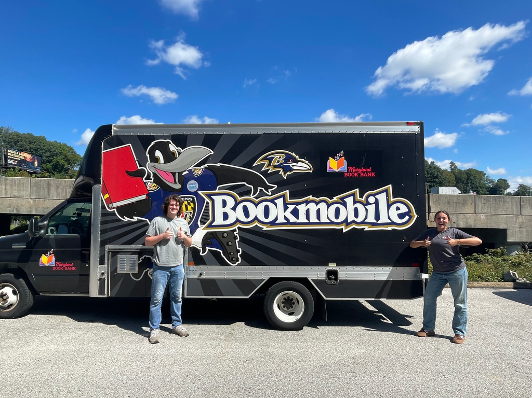
● The Home Library Program provides children from PreK through third grade with free, high-quality, diverse books that they can choose and keep from the Bookmobile.
● The Book Bank warehouse space equips educators, families, childcare providers, and community organizations with books they can use in their home or classroom libraries.
● Community outreach events allow us to distribute books at community events, fairs, family resource events, and festivals so families encounter literacy support in familiar spaces.
Our staff also takes on projects to reach families who might otherwise be left behind. In 2024, for example, our amazing Lead Program Coordinator, J Lisak, organized a free book fair for incarcerated fathers in a maximum-security prison southwest of Baltimore.
Inspired by the documentary Daughters (which absolutely requires tissues on hand), J realized how the Maryland Book Bank could make an impact on the lives of children of incarcerated parents, who are statistically less likely to achieve standards of academic success. Their outcomes, however, can be transformed by access to education and a sense of community.
With more than 5 million children in the U.S. experiencing parental incarceration, the Maryland Book Bank refuses to accept their exclusion.
That’s why our team developed a program to bring books to the men’s facility, breaking the multitude of barriers the individuals there face. Our staff handpicked 3,500 books from our stock, ensured their clearance into the facility, and organized a book fair in the community space of the prison for the men to browse through. Once they made their selections of (on average) 10 books, the men were able to take videos of themselves reading those books to send to their children during the holiday season. It was important to J that the books he chose upheld the Maryland Book Bank’s guidelines, which intentionally emphasize equitable access and the highest possible book quality.
When talking about the project, J told me, “It’s more than just books. I want these people to be represented well to their children, who don’t get to see them every day. It’s already hard to be a parent, let alone be a parent behind bars.” The men choosing books based on their children’s age ranges and interest is a fantastic way to connect with their child and encourage a love of reading, a step in the right direction to fostering a literacy ecosystem in Baltimore.
Nothing in my life has been as inspiring as being a part of the Maryland Book Bank, where our team truly, deeply cares about the concepts we espouse. Every day, my colleagues and our volunteers invest in the power of literacy. The stories we hear remind us that literacy is not an abstract goal, but instead something that shapes futures. As our team looks toward the new year, we remain committed to leaving no one behind in our literacy ecosystem.


Comments